
Caldera Technical Note #06
Trade-off Guidance Across Multiple Targets
Balancing multiple targets into a project-level decision direction with AI-informed guidance.
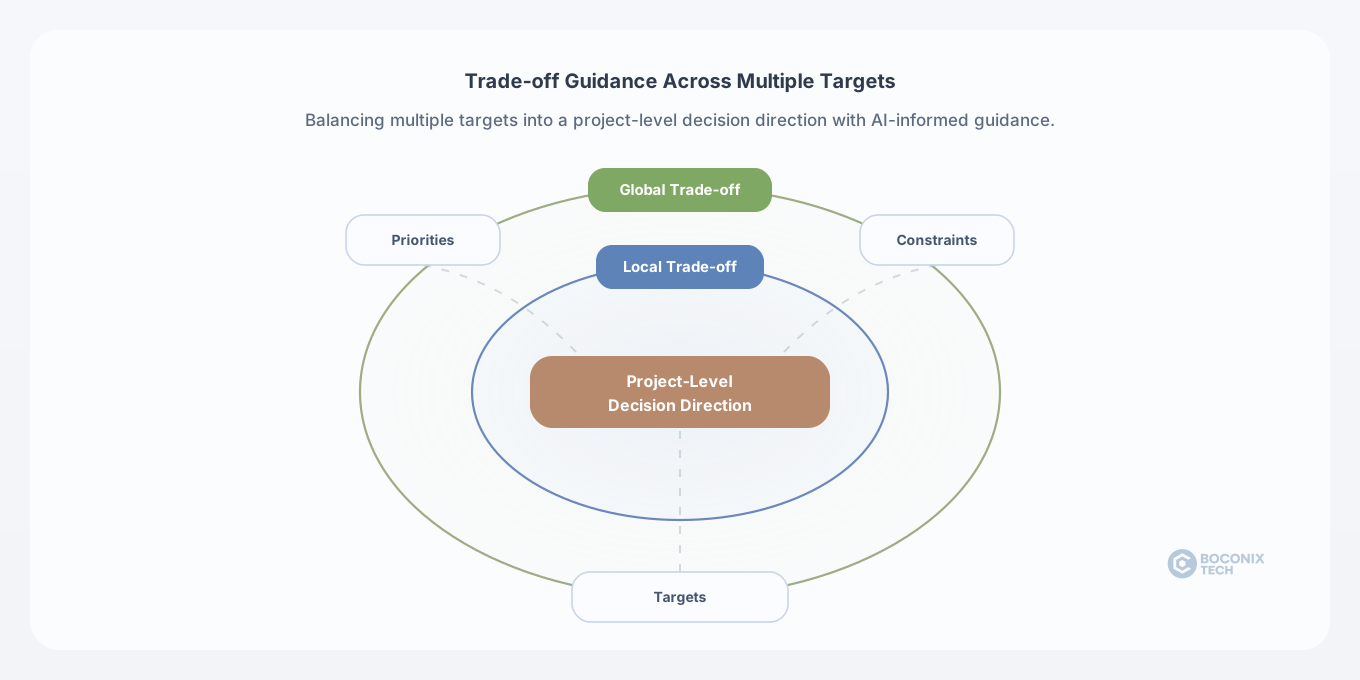
Figure 6. Trade-off guidance connects local trade-off views with project-level decision direction.
Why Trade-off Begins After Response-Specific Guidance
Response-specific recommendation clarifies what each response wants; trade-off guidance decides how those requests should be balanced together.
Technical Note 05 separates exploration, exploitation, and extrapolation for each response. That layer matters because different responses can call for different next-step logic even under the same process conditions. One response may still need learning, another may already justify a strong interior move, and a third may only justify cautious extension near the boundary of current support.
Trade-off begins once several of those response-specific signals have to matter at the same time. At that point, the question is no longer only what each response prefers on its own map. The question becomes how several responses should be weighed when the project must move in one usable direction rather than several competing ones.
This is where Caldera becomes useful as an AI-informed trade-off layer: it can bring several response-specific signals into the same visible decision frame before a single operating direction is chosen.
Local Trade-off Guidance
Local trade-off guidance is the trade-off layer that operates inside the active plotted view. It balances the responses currently in frame and turns them into a defensible compromise point, region, or direction under the present assumptions. This matters because a plotted view is often where a practical engineering tension first becomes visible. It is where a team can see that one response improves while another starts to bend, or that a region remains acceptable only while a second response stays inside a tolerable range.
That is already a real decision capability. A local trade-off view is not a placeholder and it is not merely descriptive. It gives a concrete way to compare competing responses in the same visible operating frame and to screen whether a balanced region appears credible enough to act on. It can also show when an apparent improvement only seems convincing because one response is being considered alone. A useful check is whether that gain still holds once the other plotted responses and practical limits are brought back into the same decision frame. In practice, that can be enough to support a meaningful next move, especially when the immediate decision is tied to the plotted responses already under discussion.
Global Trade-off Guidance
Global trade-off guidance is an advanced capability because it weighs multiple targets inside a project-level decision frame.
A globally balanced direction is not simply a plotted compromise. It asks a different question. Instead of asking whether the responses currently shown in one view can be reconciled, it asks whether the project should move in that direction once the full target set, practical boundaries, and stated priorities are all taken seriously. A region that looks persuasive in one plotted trade-off may lose force when another response is restored to the frame, when a process limit becomes binding, or when the real project objective shifts from local upside to operating robustness.
This is why global trade-off should be treated as an advanced decision layer rather than as a cosmetic extension of local balancing. Its value is not that it produces a complicated answer. Its value is that it can align the recommendation with the decision the project actually has to make. That frame matters most when the project must choose not only what looks promising now, but what remains credible across the next sequence of decisions.
Why Priorities and Constraints Matter at Both Levels
Trade-off guidance is not the same as averaging targets. Some responses act like upside. Others behave as constraints. Some can tolerate compromise, while others define whether a candidate region is still usable at all. A strong trade-off layer therefore has to read not only where responses improve, but also what kind of role each response plays in the decision.
In practice, this balance is formed by reading competing responses together under stated priorities and practical constraints, rather than collapsing them into a simple average.
That is true even at the local level, and it remains important at the global level. A development project may accept reduced peak performance in exchange for stability, quality, or a region that is easier to validate credibly. Those are not secondary cosmetic preferences. They define what a balanced decision actually means. Trade-off guidance becomes useful when those priorities are made visible enough that the compromise can be interpreted as deliberate rather than accidental.
What Good Trade-off Guidance Looks Like
A good trade-off output should make three things clear: what it preserves, what it gives up, and why that balance is acceptable now. Without those three elements, even a neat-looking compromise can remain weak as an engineering decision.
This is why a trade-off output is often understood as a defensible direction or region rather than a single mathematically attractive point. A narrow local optimum may look impressive while protecting too little of what matters elsewhere. A region may look modest while holding together the actual project requirements. Good trade-off guidance makes that distinction visible. It helps explain why one direction deserves to be pushed now, why another is being deferred, and why the current evidence is strong enough to justify that choice.
Summary
Trade-off guidance matters because process decisions require response-specific recommendations plus trade-off judgment.
Caldera uses AI-informed guidance to support a defensible operating direction when multiple targets must be balanced, making trade-offs visible in local views and usable in project-level decisions.
This perspective helps:
- translate response-specific signals into a defensible compromise direction
- treat local trade-off as a concrete decision layer rather than a purely visual comparison
- frame global trade-off as a project-level capability for multi-target balancing
- make priorities, constraints, and acceptable compromise explicit before a direction is chosen