
Caldera Technical Note #04
Extrapolation Risk and Uncertainty
Using AI-assisted process-map interpretation to examine extrapolative regions beyond current experimental coverage under sparse experimental data.
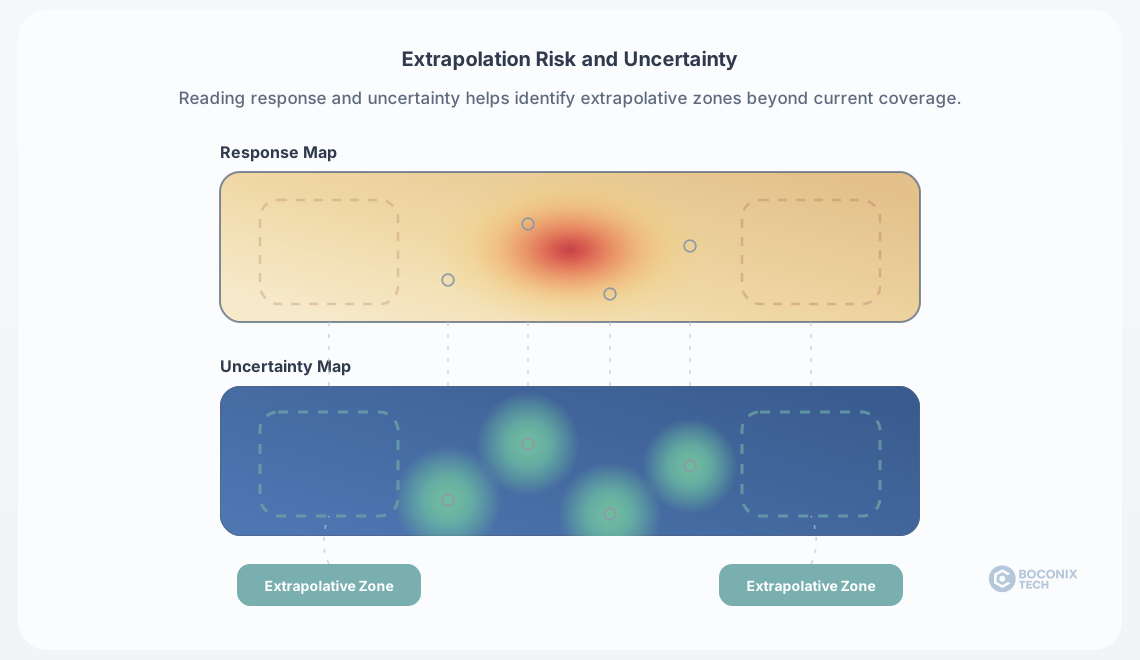
Figure 4. Reading extrapolative regions beyond current experimental coverage by considering response behavior and uncertainty under sparse experimental data.
How Caldera Handles Extrapolative Regions
Caldera can extend process maps modestly beyond current experimental coverage so continuation can be inspected explicitly rather than left implicit.
That extension is not presented as equally supported with in-coverage regions. Its purpose is to show whether a response appears to continue smoothly, flatten, or turn as it moves beyond the measured domain, while keeping the interpretation tied to caution rather than certainty.
In practical terms, this makes extrapolative regions useful for hypothesis generation, edge-case review, and planning follow-up experiments. The map still makes it possible to inspect what may lie beyond current coverage, but it does so in a way that keeps the continuation visible as a higher-caution part of the overall picture.
That explicit visibility matters. When continuation is shown directly, it becomes easier to judge whether it looks operationally meaningful, whether it should remain only an exploratory direction, or whether the current evidence is still too limited to justify action. The map therefore supports a more disciplined boundary discussion instead of leaving edge interpretation implicit.
Why Extrapolative Regions Require More Care
Extrapolative regions can still be useful, but they should not be read the same way as in-coverage regions.
A process map can look visually smooth across a broad domain, but once it moves beyond current experimental coverage, the continuation depends more on inferred structure than on nearby direct evidence. A favorable-looking edge extension may therefore be interesting without yet being decision-ready.
That difference matters because smooth continuation can look more convincing than it really is. Visual coherence is helpful, but it does not mean the same level of support still exists. Once the map moves beyond current coverage, the reading posture has to change with it.
This is why extrapolative regions are best treated as places for screening possible directions, forming edge hypotheses, and prioritizing cautious follow-up work. Their value is real, but it is different from the value of a better-supported interior region.
How to Recognize Extrapolation Risk
Extrapolation risk begins when the map is read outside current experimental coverage.
As Technical Note 02 introduced, uncertainty is a practical aid for reading how confidently a map can be interpreted. In extrapolative regions, that signal becomes more important because it helps indicate how cautiously the continuation should be read.
In practice, risk becomes clearer when considering:
- whether the region already lies beyond current experimental coverage
- how the response behaves in that extrapolative zone
- what the uncertainty suggests about how cautiously that continuation should be interpreted
Response and uncertainty are most useful when they are read together. A response map may show a direction that looks favorable, but the uncertainty view helps determine whether it is strong enough to act on now or whether it should remain a higher-caution candidate for validation.
Higher uncertainty does not automatically make a region irrelevant. Some extrapolative zones may still be worth testing if the learning value is high enough. The practical point is to keep the decision meaning explicit: stronger support justifies stronger conclusions, while weaker support shifts interpretation toward validation and controlled exploration.
How Caldera Helps Reduce Extrapolation-Related Risk
Caldera is designed to reduce the chance of over-reading extrapolative structure under sparse data. It does this by keeping extrapolative interpretation disciplined, explicit, and grounded in process understanding.
In practice, that means showing extrapolative continuation in a way that remains plausible, stable, and reviewable under limited coverage. The system helps make visible what may continue beyond the measured domain without presenting that continuation as automatically trustworthy.
This also means that extrapolative regions are not left as hidden assumptions. They remain visible enough to judge whether a continuation appears worth testing, whether it should remain provisional, or whether it is still too weakly supported to influence a decision yet.
Just as importantly, Caldera keeps expert review central. Process knowledge, practical constraints, and engineering judgment remain part of the interpretation loop before stronger conclusions are accepted. The system helps organize and clarify that judgment; it does not replace it.
This matters most when the map begins to look persuasive near the edge of coverage. In those cases, Caldera is meant to slow down overconfidence rather than accelerate it. It helps clarify whether an edge continuation is a direction worth testing, a condition that still needs confirmation, or a pattern that should remain provisional until more evidence is available.
The goal is not to remove extrapolation risk. The goal is to make extrapolative interpretation more transparent, more cautious, and more useful for decision-making under limited data.
Summary
Caldera supports controlled extrapolation beyond current experimental coverage, making extrapolative regions useful for hypothesis generation, edge-case review, and planning follow-up experiments. These regions, however, should still be treated as higher-caution parts of a process map.
Caldera makes extrapolative continuation explicit, uses uncertainty to support more disciplined interpretation, and helps avoid overstating what limited data can support.
With limited experiments, the objective is not to force certainty beyond the measured domain. It is to build the most trustworthy map possible without overstating what current data can support.